On the evening of September 27 the Jesuits from the Goa province will celebrate a mass at the Basilica de Bom Jesus to mark 200 years of
their restoration. Celebrations are very low key and have been going on in the form of seminars and talks through the year. “This is not an occasion to glorify ourselves but it calls us to revisit our past and reflect on why we were suppressed and how loyal we have been to our vocation and what’s our role now,” says Fr Gregory Naik SJ. At the time of their expulsion, the Jesuits ran a large number of parish churches and educational, charitable, social and religious institutions thatthey had set up in Goa. Overnight they found their lands confiscated to the state and others entrusted to the archdiocese. These were never restored to their original owners. The Goa province of the Jesuits as it is known now was re-established only in 1993 and is today the third smallest province in India with Delhi and Pune after it. The peculiarity, Fr Naik says, is that although they are small in number, they have generously given some of their best men for work the world over. Fateful decree The fate of Jesuits in Goa changed on September 25, 1759 when a ship arrived with a copy of the royal decree ordering
the arrest of all Jesuits in Portugal and its colonies and seizure of all properties belonging to them on the fabricated charge of their complicity in a plot to murder the king The events unfolded rather quickly within the next two days. All the Jesuits were rounded up and kept as prisoners
in St Paul’s College (the new one). In Salcete, the Jesuits were first locked up at Rachol for two months and then sent to join their colleagues. Some prisoners were distributed among houses belonging to other religious orders and werenot treated well there. “After a year all the prisoners were returned to St Paul’s as the transport ship Nossa Senhora de Conçeicão was to arrive. When it did, the 137 prisoners were loaded on it, a ship meant for maximum 100, an on December 19,1760 it departed on a journey that lasted five torturous months. The conditions on the ship were so unhealthy and subhuman that by the time it reached Lisbon 24 Jesuits had died and were buried a sea,” Fr Naik writes in his compilation The Goa Jesuits -A concise account of the origins of the Goa Province.
The Jesuits who arrived in Lisbon faced
no trial, but were told they could save
themselves by leaving their society. The
Portuguese-born were exiled to papal
states in Italy. The others were sent to S
Juliao da Barra jail where they suffered.
In Portugal, the orders for the expulsion
of the Jesuits came from the Portuguese
Prime Minister Sebastião Jose de Carvalho
e Mello who was later made the Marquis
of Pombal. Jealous of Jesuit influence,
he also wanted the church to be subordinate
to the state.
On September 3, 1758 there was an
attempt on the life of King Joseph I on
the outskirts of Lisbon when he was returning
after an evening with his mistress
who married into the influential Tavora
family. The Duke of Aveiro and the Marquises
of Tavora were arrested, tortured,
executed and their bodies burnt and
thrown into a river.
On January 19, 1759 the king ordered
that all Jesuit property be confiscated
and three months later on April 20,
1759 all Jesuits were exiled as rebels
and traitors. They were accused of rebelling
against Portugal and Spain in
the treaty of the Paraguay Reductions,
refusing to yield to civil authority in
Brazil, corruption, commercial activities
forbidden to clerics, the defamation of
the king abroad and making an attempt
on his life.
Portugal was the first European country
to expel Jesuits with others following
its example. France suppressed the
Jesuits in 1764 and Spain in 1767. It
was only much later on July 21, 1773
that Pope Clement XIV under pressure
suppressed the society worldwide
through the brief Dominus ac Redemptor.
Ironically Catherine II of Russia, an
Orthodox and Frederick of Prussia, a
Lutheran ignored the brief of suppression
of the society in their kingdoms
because they wanted to keep the Jesuit
institutions running. Many Jesuits continued
to work in Europe during the
suppression affiliated to the Russia
province and with their superior based
in Russia.
Pre expulsion the Jesuits were at the
zenith of their influence on European
society. They controlled the world of
education and were confessors to kings.
In Goa too, the society was a very vibrant
one. In fact the Goa province was
the third oldest (and the first outside
Europe) of the Jesuits after Portugal and
Spain.
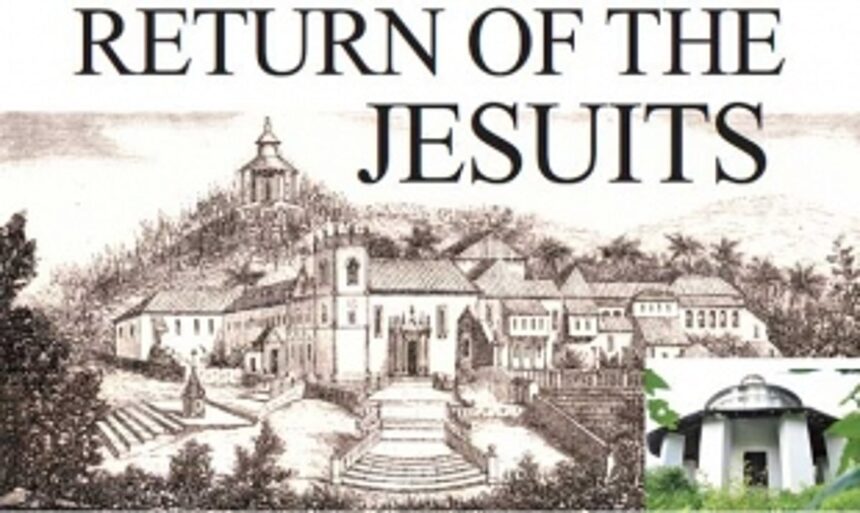
St Francis Xavier was the first Jesuit to
arrive in Goa in 1542. The professed
house or Casa Professa (the heart of the
society) of the Jesuits who had completed
their final stage is attached to the Basilica.
The Casa Professa was built approximately
in 1585, before the Basilica was built. It
was the only professed house in entire
East Asia.
“It was confiscated along with all the
other properties of the religious and returned
to the church only in 1940. A
Jesuit was appointed rector of the Basilica
only in 1956. There were only administrators
before that,” Fr Savio Baretto,
present rector of the Basilica says. The
present structure is believed to be only
one third of the original one.
In 1555 the Goa territory consisting
Ilhas, Bardez and Salcete was distributed
among the existing three orders for the
purpose of the apostolate. The Franciscans
were in charge of Bardez and the
Jesuits were given charge of entire
Salcete and 15 villages in the north
western sector of Ilhas. The Dominicans
were given the other villages in the
Ilhas.
contribution to Goa
The Jesuits ministered in Salcete for
over 200 years and this became their
mainstay. They built 25 churches in this
taluka. The Seminary of Rachol was built
by the Jesuits where they ran a college
with a hospital, orphanage, catechetical
school, primary school in Portuguese,
Konkani school for European missionaries,
moral theology and the first printing
press.
In Ilhas, the Jesuits acquired the Seminary
of Santa Fe, consecrated the church
of the college in honour of St Paul and
it came to be known as the College of
St Paul. The Jesuits who worked there
were called Paulistas.
“The college housed a novitiate, a
Jesuit residence, a hospital, a dormitory
for catechumens and a good library. Besides
academics, the college was the
hub of Jesuit activity in the east. It was
the church of this college that had the
privilege of having the first public exposition
of the incorrupt body of Francisco
Xavier soon after it arrived from Malacca,”
Savio Rodrigues writes in Jesuit Heritage
in Goa.
When the plague broke out in Old
Goa in 1570 the college was abandoned
and a new one built near the convent of
St Augustine which came to be known
as the new College of St Paul.
The medical department of the College
of St Paul was credited with running the
Royal Hospital and the expertise of the
engineering department was used in
building the Rua de Ourem and Ponte
de Linhares, considered a marvel of engineering
at the time.
the awaited Bull
The Jesuits celebrate 200 years of the
restoration of their faith this year thanks
to Pope Pius VII who after returning
from captivity in France by Napoleon
signed the papal Bull Sollicitudo Omnium
Ecclesiarum (The Care of all Churches)
on August 7, 1814 which restored the
society.
The situation in Portugal however
didn’t receive immediate respite because
of its antireligious rulers.
In spite of the Bull, the Portuguese
government refused to permit Jesuits
to settle in Goa. So although there were
four flourishing Jesuit missions in Madurai,
Bombay-Poona, Bengal and Mangalore,
the Goa mission came into existence
only on December 3, 1889 and was operating
from Belgaum. Fr Naik writes,
“In fact between 1891 and 1908 the
total number in the Goa mission at any
one time fluctuated between five and
nine Jesuits.”
In 1928 the Archbishop Patriarch
Dom Mateus d’ Oliveira Xavier asked
for two Jesuits to be sent to Rachol
Seminary. Fr Bernardo Gonçalves was
installed as spiritual director in 1931
and he became the first Jesuit to permanently
reside in Goa but not in a
house of the society.
In Portugal in 1932 when the Estado
Novo party came to power, Dr Antonio
de Oliveira Salazar was appointed Prime
Minister. When he promulgated a new
constitution, he permitted the return of
religious orders.
On March 19, 1934, 40 prominent
citizens, mostly from Margao, submitted
a joint petition to Patriarch Dom
Teotonio Vieira de Castro stating the
Jesuits had given “incontestable proof
of their competence as educators”
and therefore they should set up a
school or small boarding in Panjim as
soon as possible. The signatories were
lead by Dr Antonio Augustro do Rego
of Panjim and included Sales da Veiga
Coutinho, Felippe da Piedade Rebelo,
Cesar Baronio Monteiro, Antonio Colaço,
Francisco Correia Afonso among
others. The original letter drafted in
Portuguese lies in the archives of the
Jesuit House in Panjim.
The Jesuit provincial of Portugal regretted
that no Jesuits could be spared
at the time. But the citizens persisted
and when they read of Fr Estanislau
Martins coming from Portugal they insisted
he be assigned to Goa. The patriarch
passed on the message to the superior
general in Rome and his response
was positive.
post restoration
Three Jesuits Fr Silvestre de Souza (a
Goan) superior, Fr Estanislau Martins,
director of the school and Bro Vincent
Augustine, administrator rented a small
house at Fontainhas “at the left end of
the Rua do Povo de Lisboa facing the
canal flowing into the Mandovi”. Twenty
boys were admitted as boarders and 30
enrolled as day scholars in the lyceum.
The Insituto de Sao Francisco Xavier
was founded on July 2, 1935 and the Jesuits
in Goa got their first residence in
the restored society.
The institute turned out to be a failure
because the director lacked experience
and aptitude to deal with the youth.
Eight years later it shut. They continued
to struggle because of their small numbers.
They managed to restore the faith
the people had in them when they
began running St Theotonius Union
High School in Margao in 1944—the
present Loyola High School.
In Mapusa they rechristened the Sacred
Heart High School as St Brittos
High School in 1948. Today they also
run the Xavier Retreat House in Baga,
St Paul’s School in Belgaum and Rosary
English High School in Ajra. They have
the Pedro Arrupe Insitute in Raia, their
own research centre the Xavier Centre
of Historical Research in Porvorim and
have greatly contributed to Konkani
through the Thomas Stephen’s Konknni
Kendr. The Jesuits also run the Jana Jagran,
a social action wing where they
work with shepherds and nomadic
groups and also impart non formal education
to them.