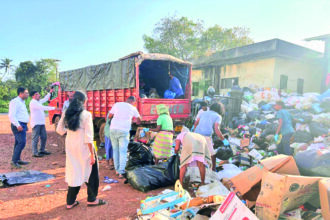
Saleema Habib, 33, stares vacantly ahead as the local social worker Zahira Shaikh jots down the details of how her three-month-old infant died. The baby had not been keeping well for two weeks and had died of diarrhoea, she said.
“Many deaths are attributed to pneumonia, TB and diarrhoea instead of malnutrition in these areas, so we have to be extra cautious and get more details,” said Shaikh, as she wandered through Govandi, a sprawling, congested slum, home to 60,000 impoverished people, mostly migrants, on the eastern periphery of India’s financial capital.
Govandi is a microcosm of urban India’s burgeoning challenges of poverty, overcrowding and malnutrition, with many like Shaikh’s daughter slipping between a variety of policy and implementation cracks.
Govandi’s people are among 24 million people in Mumbai and New Delhi living in urban slums, or roughly half the population of India’s two mega cities. These two cities account for more than a fourth of 95 million Indians in urban areas living in poverty, according to various studies—and, so, at risk of malnutrition.
In Delhi, half the city’s two million children are already stunted from malnutrition, which a recent Scroll story called “a hidden epidemic”.
Over the next five years, India’s urban population is projected to double to more than 800 million, of which about 200 million—more than twice the current population of Pakistan—is likely to live in poverty. The population growth rate of slums is double the growth rate of the overall urban population.
Hidden and under-reported, malnutrition among so many will be difficult to record and—as current evidence indicates—not amenable to easy solutions.
Mumbai’s publicity blaze over infant deaths, but Govandi stayed the same
Three years ago, reports of infants dying from malnutrition in Govandi attracted much publicity and government action. Health workers and doctors were deployed and in an urgent bid to tackle the crisis, a malnutrition-treatment centre was set up.
A year after it opened, the centre was shut down. The reason cited by Apnalaya, an NGO that ran the centre: “insufficient outcome of the effort”.
The three-year programme was “very costly but failed to yield results”, said Dnyaneshwar Tarwade, spokesperson for Apnalaya. “Basically, we had spent Rs 5 lakh over three years on 35 children and we saw no results.”
An internal assessment by the NGO revealed that this was because by treating malnutrition at the centre only, parents and the community–vital stakeholders–remained uninvolved.
Poorly counted, disputed, but India’s malnutrition still among world’s highest
About 1 million children under the age of five die of malnutrition-related causes in India, according to UNICEF. From the arid lands of Rajasthan to the urban slums of Mumbai, the government has not been able to reduce what are some of the highest malnutrition figures in the world.
Some dispute India’s malnutrition data, contending that the last time nationwide infant-health figures were released was 2006, and a limited survey later indicated a fall in malnutrition.
Yet, this correspondent’s tours to many parts of India indicate that malnutrition, associated with poverty but not exclusive to the poor, is a continuing issue in rural and urban India. This piece focuses on urban malnutrition.
In urban families, who may not be officially poor but do not have access to nutritious food—either through ignorance, changing food habits and time pressure—the problem is especially evident, as the continuing malnutrition in Mumbai’s slums indicates.
Fast food, long work hours and poverty drive urban malnutrition.
The food-security status of 377 million inhabitants of India’s urban areas, of which one-fourth live in extreme poverty, is poorly documented, as the case of Mumbai indicates.
One in six, or 60% of Mumbai’s population lives in slums, and some 10 million live under threat of constant displacement. For these millions whose work days are often marked by long commutes, long hours and intense physical activity, food is low on the daily priority list.
Children are especially vulnerable to the easy availability of packaged food and irregular, unbalanced diets. Poor diets can slow growth, decay new teeth, promote obesity and sow the seeds of infirmity and debilitating disease that ultimately lead to malnutrition. Food containing low nutrition value tends to reduce the IQ level of children.
Packaged food–popularly called junk food for its low-nutrition qualities–said social workers and experts, has started infiltrating homes of even lower-income and marginalised groups.
Junk food is unhealthy for the digestive system as it slows down the digestion process, bloating the stomach. In addition, when the intestine absorbs the food, it requires fibre and water to excrete but junk food lacks these nutrients.This leads to poor digestion and irritable bowels.
The outcome is malnutrition.
Malnutrition can lead to a permanent reduction of a child’s future learning capacity and negatively impact the economy, experts warned.
An important factor for growing malnutrition in urban areas is the lack of planning and policies for the marginalised. In Mumbai, the city’s development plan ghetto-ises people, leading to a cycle of denial of housing, amenities, schools, open spaces and health care.
As much as 60% of Mumbai’s slum population lives on 8% of the land, according to a study by the NGO YUVA.
(Boga is a Mumbai-based journalist
and researcher.)