While Goa managed to retain its identity through Opinion Poll over 50 years ago, the increasing spurt to occupy land in the coastal State has once again put the State at the risk of losing its ethos. Protecting Goa’s land is the most debatable issue for the very fact that huge tracks of land are being sold to outsiders, raising an alarm whether Goa’s citizens and its future generations will ever be able enjoy the resources that was protected through the only referendum held in the Independent India.
While outsiders are indeed taking over Goa’s land, unarguably our very own Goans are selling it for handsome price. Lawmaker and Lok Sabha Member of Parliament Narendra Sawaikar agrees saying, “Compared to other states in the country, Goa’s land area is smaller. Is it fair on our part to sell land/properties to outsiders? They might use it for commercial purposes. We need to self-impose restraint by not selling our land and ancestral properties to non-Goans.”
Former Union Minister for Law Ramakant Khalap has expressed anguish over the present trend on the issue of land in the State, claiming that Goans would be reduced to a minority in the near future.
“Goa is flooded with immigrants who have made Goa their home, while Goans are out-migrating. The present demographic profile puts Goan and non-Goans at 50:50. This ratio will further dwindle in the next few decades, reducing Goans to a miniscule minority. In the absence of any curbs on land transfer much of Goa has already been sold. What remains will be usurped by land sharks in the next decade if not earlier. Data from land registration offices of land transfers hitherto should be an eye opener,” he said.
“As per a newly-enacted law usurpers as well as lawful holders of government, lands will now be able to purchase these lands at Rs 5 per square metres and sell it for much higher price. There appears to be a huge conspiracy involving bigwigs and land sharks,” Khalap claimed.
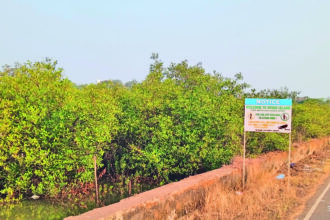
Goa has more than 33 per cent of its geographic area under government forests (1224.38 km²) of which about 62 per cent has been brought under Protected Areas (PA) of Wildlife Sanctuaries and National Park. The total forest and tree cover constitutes 56.6 per cent of the geographic area, which certainly means these zones cannot be touched for development purpose. Moreover, there is another 10-15 per cent land identified as no-development zone under Coastal Regulation Zone, and 36,000 sq meters of land is locked in Special Economic Zone. This is apart from huge space of agricultural land.
Now with less than 40 per cent of land available for settlement and commercial purpose, one can see large number of illegal conversions too. With real estate business booming, a large number of non-Goans are buying agriculture and orchard lands in Goa for hotel, residential and other commercial projects. Some cases go unnoticed too. Now with the present Town & Country Planning Minister Vijai Sardesai warning to file an FIR against land owners and the project developers for illegal land conversion, it is here to see whether rampant illegality stops. Recently, an FIR was also lodged in one such case in Poriem village.
While we speak of wealthy outsiders buying Goan land and some ancestral properties, and illegal conversions; there have also been instances of illegality on government land. Goa was shaken by large scale illegality and irregularities in Comunidade land at Serula, Colvale and Pedamol. The scam is not only of illegally giving away comunidade plots but also loss of power and water for the government. For example in Pedamol, if the properties were not registered, then on what basis were electrical connections given and in whose names power bills were generated. It is learnt in Velguem Comunidade land was being sold at the rate of Rs 90,000 per sq mts, when government records had indicated that the comunidade did not have free land for sale.
The illegal sale of comunidade land has been echoing in almost every Assembly session. In 2016, the then deputy chief minister Francis D’Souza wondered how to control the sale of Comunidade land even to the outsiders, when it is supposed to be a community land for the benefit of the locals.
Sawaikar argued that illegality should be dealt with strictly as Goa has the unique Code of Comunidade to preserve the land. “I can understand the (government) land is being utilised for setting up any institution or public bodies, or even for housing purpose. It should not be misused… If there is vested interest, the whole purpose is defeated,” he commented to question on the exposes in some comunidades.
Khalap rued the crumbling of the institution of Communidades, alleging that most of the slums were in Comunidade land.
Goa is also reeling under the Tenancy Rights controversy wherein tenants and mundkars are fighting over the rights to the land. There have been instances wherein tenants, some of whom are non-Goans have claimed rights over the land arguing they have lived there for several years and paying all utility bills. Thousands of cases are being heard in this regard.
Responding to these issues, advocate Yatish Naik opined that Goa earned its unique identity owing to the struggle of thousands of Goans and it was imperative to reaffirm commitment to the welfare and progress of the State.
“Goans must remember the great work and sacrifices of these great Goan men and women who worked tirelessly for the sake of Goa and its people. We therefore must work towards retention and preservation of this unique Goan identity especially in these critical times,” he said.