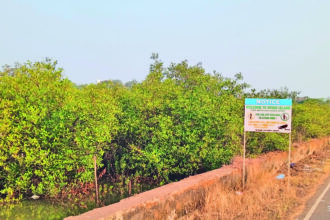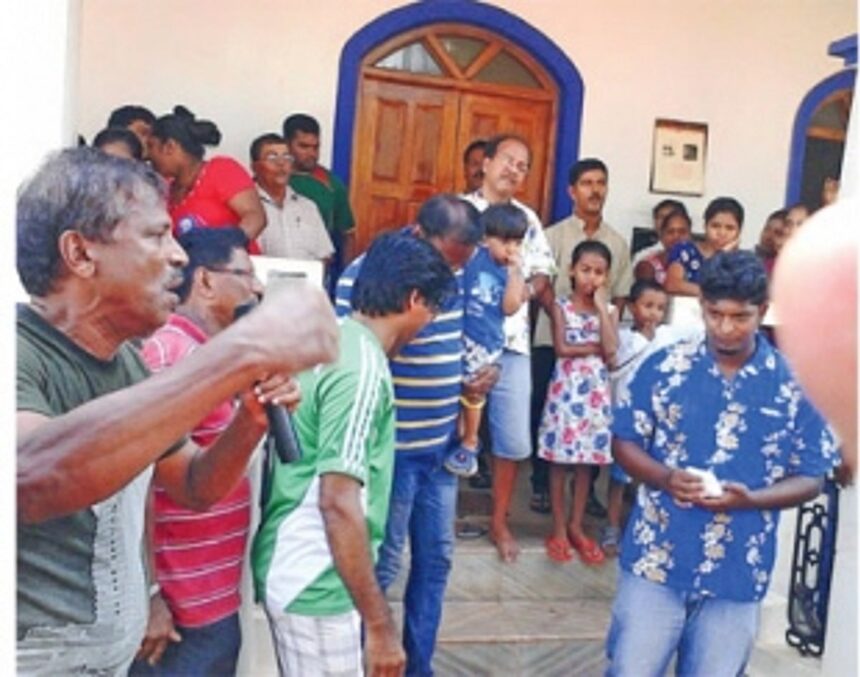
Tiracol or Terekhol as written on many sign boards leading up to the place is every bit the village life one would expect: Chickens running from one neighbor’s house to the other, dogs barking at every passerby on the road. The people: just as friendly, cordial and helpful as any Goan, a typical Goan village with its occasional quarrels and celebrations all the same. But this village situated on the border of the state, is dealing with an issue that has got many fighting tooth and nail with the government to protect their once flourishing land.
But before all the unity was a time of tribulation for the 300 odd people that currently reside in the village. Resident Francis Rodrigues was born and brought up in the village. As a child he would help his mother in the fields and his father who was a cashew farmer. But in 2012 when he and his fellow villagers got
wind of plans of a golf course along with 128 resort villas and 60 premium resort villas. Rodrigues and his family were naturally the occupants of the land, and were mundkars. As per a sale deed from the owners the Khalap’s, Sandip Ganguly of Leading Hotels Pvt. Ltd. bought the entire area measuring 12,50,000 sq mt. Investigations carried out by this paper later revealed huge irregularities in granting of permission for the golf course to be developed by Ganguly’s company.
While 14 of the nearly 30 tenants submitted a negative declaration to the Mamlatdar of Pernem, the remaining 13 that haven’t given up their land formed the St. Anthony’s Mundkars Association to fight against the bhatkars actions.
For a mundkar, submitting a negative declaration to the Mamlatdar amounts to giving up his right to the land. Essentially, the mundkar gives in writing, that he is not the tiller of the land and has no share of it, either as owner or as a mundkar. Sato D’Souza remembers hotel personnel approached every family, his included, saying they wanted only four lakh sq meter for their project promising them a share of the project itself. D’Souza who worked in the US for a couple of years was unaware of the illegalities and corruption in his village. Many like him were working or residing in Mumbai. “They told us they wanted only four lakh square meters of the land and made promises that the project would benefit the villagers alone. Villagers were given money to sign a piece of paper that turned out to be a negative
declaration,” he says adding that they slowly began offering varying amounts of money to each family for their signatures.
They slowly managed to get hold of 60
percent of the land,he says. “But ever since
they realized it was a fraud, they have joined
those that still have mundkarial rights in
fighting to safeguard the village,” says D’-
Souza.
One of the biggest supporters and helpers
for the village is Fr. Jevino Pereira. A Diocesan
priest, Fr. Jevino first came to the village
thanks to the parish priest of the Querim
church and parochial admistrator for Tiracol,
Fr. Theo Jose Fernandes. He remembers of
the divide among the villagers when he first
came to stay at the “PadriGhor” built for the
priest before Fr. Jevino. “The entire village
was torn into two. One was those that sold
their rights to the land and the other was
the one’s that didn’t.
Sometimes the
enmity was so
fierce, neither
would go to either’s
functions and
events. They were
not even on talking
terms,” he says. Realising
the issue at
hand was the loss
of an entire village,
Fr. Jevino decided
the only way to fix
the problem was to
get the two groups
together.
Weeks following
his entry into the
village, he introduced
many community
events like a fishing competition,
badminton and volleyball games, even a
tiatr. His Sunday sermons would also center
on unity in the community.Fr. Jevino’s argument
is that if the state has already declared
the residents as tenants, how is it that they
are allowed to sell it, it goes against the
constitution, he says adding that the negative
declarations too go against the law.
For many who still live in the village,
getting by is easy and sufficient. Joaquim
Rodrigues and his wife ran a restaurant in
the Tiracol fort when the Tourism department
leased it out to a private party for a period
of 27 years. Since the expiry of the lease
earlier this year the hotel was closed and
with it, Rodrigues and his wife had to shut
shop too.
“We have cashew fields that we use to
cultivate, but that would take up only three
to four months of our time. The rest of the
year, we don’t have anything to do. That
was when Fr. Jevino suggested we open a
small ghada outside the fort for tourists,”
says Rodrigues who sells fresh lime soda
and tender coconuts to the many tourists
that visit on a daily basis.
He was one of those that didn’t sign any
negative declarations, and like the rest of
the village is ready to fight to save their
lands for their children and the future generations
to come.
Cecillia Mendes, is in her 70’s but she
recalls the time when she would toil away in
the fields while her husband was busy making
the cashew feni or urak while her three sons
and two daughters grew up. She says she
has no recollection of the badhkar coming to
collect any fees from her back in the day.
As for the proposed bridge linking Keri
and Tiracol, everyone has only one opinion,
“As long as it has the backing of the hotel,
we don’t want it.”
Mendes’ son, Anthony along with Fr. Jevino
and the rest of the villagers have been actively
standing up for their village. He says it is
very evident that the Leading Hotels has a
hand in the building of the bridge.
“On the day of the inspection following
the NGT’s orders, (dated December 1, 2014
ordering no felling of trees as well as a site
inspection and subsequent report by the
Deputy Conservator of Forests on the existing
forest area) the department officials came
at 6.30 pm for the inspection. Along with
them there was a member of the Leading
Hotels also,” says Mendes.
Francis Rodrigues, another resident has a
small restaurant, the earnings of which he
uses to give his children an education in the
Keri government school. With a ferry that
stops service at 10 pm and having to go to
Maharashtra for the daily shopping, he says
the bridge will certainly help make access
to Keri and Arambol much easier, but not at
the cost of the village.
Emotion is running high in the village.
And so is interpretation of events which
borders on the irrational but totally understandable.
Sample this. “In the past, the
leopard (who lives in the forested area of
the village and has a mind of his own) has
never harmed anyone. It would be at arm’s
length from us, and would not hurt anyone.
At the most it would catch a dog for a meal.
But the villagers as well as I have noticed
that every time anyone from the Leading
Hotels comes, he tends to get agitated,”
says Fr. Jevino.
Despite all the mess the villagers have got
themselves into, they along with Fr. Jevino
are determined to succeed in their mission
to ‘Save Tiracol’.
Review Bureau