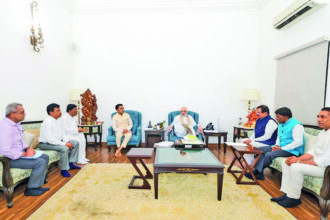
Members of P. G. Kamath Foundation’s Konkani Sahitya Akademi, Kerala sit in a stall marked G-3 surrounded by books, some serious looking, some with colorful pictures with some informative ones too. Read the titles and you realize its Konkani written in the Devnagri script.
At the time of the Portuguese invasion in Goa, many left the land in hopes of preserving their culture, one of the many that fled settled in Kerala. The Kerala Konkanis as they are called left Goa on the pretext of saving themselves from the Portuguese but with no written literature to take with them, they struggled and still do, to keep their language alive.
Payyanur Ramesh Pai, Chairman of the organization says it was their need to fit in that mattered more at the time rather than the language. “We wanted to maintain our culture which is why we fled, but when we left, we didn’t take any literature with us. At the time, the Portuguese were burning all that was not written in a language they understood, so we couldn’t take anything with us. To retain and develop literature at that time was not seen important. At that time, the most important thing was to settle down,” he says.
But after 400 years of the migration, he says comparing the vocabulary between the two communities; at least 80 percent remains the same. “We have been able to retain about 80 percent of the vocabulary, which in itself is a big thing. The rest may have been corrupted due to the influence of a new culture or maybe it was forgotten or simply replaced,” says Pai.
Much is also evident from the Konkani speaking community that now resides in the country. In the town of Shashti Parambuthat carries the Konkani equivalent of Salcette in its name, it is clearly evident the residents and their ancestors came from villages in Goa’s Salcette taluka.
Tchoi and podem both have similar meanings, but residents of the Shashti Parambu village use the former, a term Goa’s shashti’s use too.
Though some aspects remained Goan, the Malayalam cultures eventually seeped in too. “An overwhelming influence of the local language also began to happen. Sustaining the language became difficult. So in our temples bringing elephants is common practice. Playing the chenda playing is also common. Here in Goa however, that is not the case,” says T. R. Sadananda Bhat, member secretary of the Akademi also visiting Goa with the book stall.
With a little less than 12 lakh Konkani speaking community among the 3.5 crore population of Kerala and regular programs in Konkani at associations, efforts to keep the language alive are ongoing. One of their biggest achievements was in the field of education.
Speaking the language at home was common place; among families and friends of the community was where Konkani would usually be spoken. “People used to laugh at us if we would talk in Konkani when we went to school. We used to speak only at home because we were looked down when we spoke elsewhere. We as a minority were ignored and neither did we want much. But when it came to the language, we realized it was our right to study in our language, and there was a reason to save it for later,” says Bhat.
Realizing that almost no child had the actual knowledge of Konkani, the Konkani Mandal Prachar Sabha took up the cause of bringing it to the schools. But with Malayalam, Hindi and English being the main languages, Konkani was left out. After taking the matter up with the Government of India and the Linguistics Minorities Commission, the language was recognized as an independent literary language in 1975. After years of struggles, the group managed to introduce Konkani in schools as a second (optional) language for students from the first to the fourth grade. Syllabus for the course was initially given by the Goa Konkani Academi, but in recent years, Kerala’s State Council for Education and Research Training (SCERT) devised their own syllabus with special importance to
grammar.
Pai says Goa is in Konkani paradise hoping for something like the sort in Kochi. “Here you are in paradise as far as the language is considered. It is the state language, though efforts were put into it too. Today if someone is born here, they are in paradise; they can go from KG to PG studying Konkani. Nowhere in the country is this possible,” he says.
The organization today helps anyone in Kochi that wants to write books and has received an increase in the books they publish yearly. Last year, the Academi helped publish 12 books, a value that was halved in 2013.
Of the many books published, P. G. Kamath’s Tivollim is the most popular while they also publish an annual digest comprising of poems and stories contributed by members of the Konkani speaking community.
So while people visiting may pass the stall at Kala Academy for a Marathi publication, Pai and his troupe of membrs of the Akademi hope that Goans may get a glimpse of what they have to contribute to Konkani as a language, and maybe sell a book or two.
Review Bureau