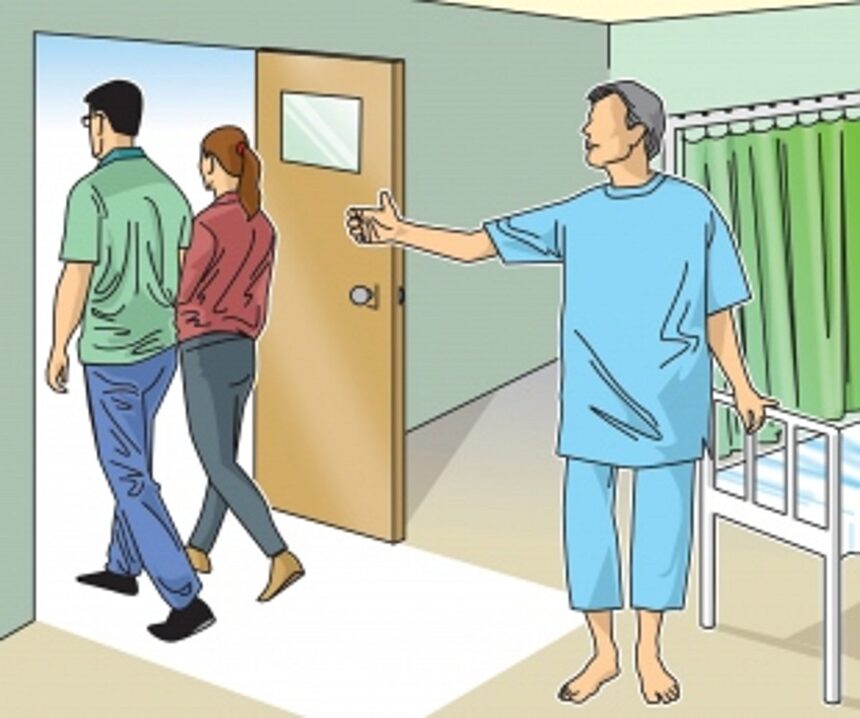
Take the case of 60-year-old Radha (name changed) who has spent over a year at the Institute of Psychiatry and Human Behaviour (IPHB) where she has received treatment for depression and fragile mental health. But though she’s been given the green light to go home, no one comes to take her. Doctors and nurses have contacted family members but nothing in the law can force the family to take her back. She is not the only one. There are 120 such patients who were admitted to the IPHB and who have recovered but are in a dilemma as family members don’t want them back home. It is a dificult situation for the 10-odd doctors to be in when patient’s families refuse to take recovered and healthy individuals home. One doctor, requesting anonymity, said the hospital had decided to place patients in a protective home in Chimbel. Some doctors and nurses who work at the institute have said that family members reason with Radha’s family’s excuse that they fear she may relapse to her old condition if she returns to her previous surroundings. “In many cases, the stressing agent lies within the family or among family members. This is one reason many families don’t want them back. There are also cases where families don’t want to deal with the responsibility of handling a person who may still suffer from mental disabilities,” said one doctor that works at the institute. Several nurses at the IPHB have also complained of crowded wards and unmanageable conditions. While each ward is to accommodate 20 beds, some have over 25 patients in one room. For lack of space, some patients are even forced to sleep on the ground. “There are cases where patients in a it have lashed out at us and have even hurt us. Cases of transsexuals in the ward have also caused fear not only to us but to the other patients too,” said one nurse while another points to unsafe conditions during the night in the hospital’s seven wards separate for the men and women. The IPHB as part of its policy allows patients to be admitted to the institute only if family members agree to a 90-day stay at the institute, but in many cases, the management is forced to keep patients for much longer periods. Falling under the ambit of a disability, patients suffering from mental retardation and mental illness under the Mental Health Act 1987, however, have no speciic clause or section that makes it legally binding on families of the patient to take their members home. Disabilities Rights Association of Goa (DRAG) president Avelino De Sa says though the law doesn’t call for speciic rehabilitation of patients the government can intervene. “It is important that those that have recovered are not placed in the same ward as patients who are still recovering. This will certainly have a negative impact on all of the hard work they’ve put into recovering. But at the same time, the law doesn’t impress on parents or family members of the patient to be taken back home. The government, however, should work on giving counseling to the parents and family members or at least start a home for those that have recovered,” says De Sa. Dr. Dorren Dias, a psychiatrist working in Margao says that in most cases patients who have recovered aren’t neglected by their families; it’s the ones that suffer from chronic illnesses that are left behind. “In most cases when patients are hospitalized in psychiatric institutions, those suffering from chronic illness are the ones who aren’t being taken home. In my opinion, these are the people that ind the institution comfortable. They are not in a frame of mind to understand that they would be in a better condition staying at home. Being in a hospital is a better option for them because they are provided for with food and medicines,” she says adding that most families do take patients home. Those that are very ill that reach a negative state and they’ve become attached to the hospital. So with no concrete place to go, what solution do these patients have? A walk around the Operational Therapy (OT) section of the 27.60 hectare land of the IPHB and it is clear to see the institution is certainly trying to help its inmates. Part-time teachers train patients in techniques of embroidery, stitching including arts including painting and singing. “We try to teach them things like stitching or making something with their hands so that when they go back home, they don’t have to solely rely on their family members for support but can live regular lives on their own,” said one trainer as she showed a patient how to do cross stitch. COOJ Mental Health Foundation is one of the many organizations that works on not only rehabilitating those suffering from disabilities and mental illness but also provide psychosocial rehabilitation programmes to help “develop and maintain sustainable and meaningful lifestyles”. Dr Peter Castelino, trustee and founder of the organisation says it is very important for them to feel welcomed back into the society as that is one of their steps to recovery. He says that while the concept of de institutionalization of and sending recovered patient’s home was good, it was important to understand the meaning of the word recovered. “If people have been kept in hospitals for a long period of time, most often they suffer from chronic mental illnesses wherein most often patients are stabilized from their acute symptoms but still have some level of disability. In order to discharge such patients from the hospital, certain basic services are required which if not available make families apprehensive of taking them home,” he says. Of these he suggests setting up cost effective rehabilitation centers where patients can continue in a program to deal with their disabilities, follow up community care as patients once stabilized stop treatment adding to the burden of the caretakers and emergency services for people who turn violent. Dr Dias too agrees that a rehabilitation centre is something the state needs to have. “What they need is a rehabilitation centre. Here in Goa, there are no homes for the psychiatrically ill people and this is what needs to be done. Going home is not the answer to their problems,” she says. Speaking about the issue, Health Minister Francis D’Souza conirmed that family members were indeed not taking their loved ones back home but that most were far off relatives and were not bound by any rules that forced them to take patients back home. “Most patients who are at the hospital were not admitted by immediate family members but by uncles or other relatives. Yes the IPHB is overloaded with patients whose families don’t take them back but we can’t force them either. We are therefore working on identifying rehabilitation homes around the state where they can be moved to. This is necessary because new patients coming to the facility are not given space as it is overcrowded,” says D’Souza.
Fit, but unable to go home
The Institute of Psychiatry and Human Behaviour (IPHB) Bambolim may have begun to cater to those su ering from mental problems but over time, there have been several cases where family members refuse to take their loved ones back home. Does the law not allow for any provision for the well being of people belonging to this community? How do the patients themselves start anew? DIANA FERNANDES fi nds out more