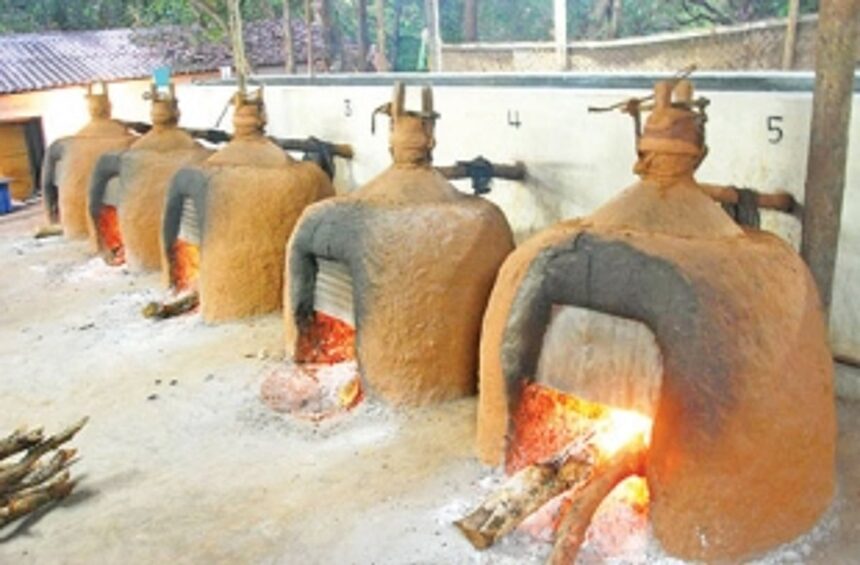
During the pandemic in 2020 Feni distillers were totally disheartened as there was hardly any sale. However, this year it seems bright for the industry, especially after the notification of the much awaited policy.
Menino D’Souza, former Excise Commissioner of Goa and now Director of Tourism had taken this up as his ‘passion’. “Yes it is my passion. Now with the notification done, it is a good beginning and it will help all the stakeholders and revive the industry with better practices. Now the policy has to implemented properly and taken up by all the stakeholders,” Menino D’Souza told Herald.

President of the Goa Cashew Feni Distillers and Bottlers Association (GCFDBA) Gurudatta Bhakta and also Managing Partner, Cazcar believes that the Geographical Indication (GI) must be exploited to the core to make Feni recognised nationally and internationally. He told Herald, “We welcome the notification of the Policy. Now the implementation and taking it forward is now with us. The onus lies with all the manufacturers of Feni in Goa. However, the State government will have to form the Conformity Assessment Board (CAB) which after the registration of our label in Chennai for GI, examines and inspects our facilities for certification of GI compliant. Thereafter we can be allowed to use a special sticker with hologram of GI tag in our bottles. How many will be able to do this in Goa is a question mark even today.”
Bhakta further added that the formation of CAB is crucial for having GI tags. “This will totally streamline the protocol of manufacturing of Feni and this will ensure the genuine product in the market as the parameters and process will be defined. The usage of aluminium foil will have to go and instead one will have to use copper pots or stainless steel or wooden barrels if one wants to age it. One will not be allowed to store Feni in plastic cans or jars anymore.”
He further added that Policy very vividly certifies three things. One is the natural Feni, second is the botanical Feni in which some spices are added and third will be the aged Feni which will normally be done in wooden barrels. “All these will now be certified by the Excise Department. In fact, now the barrels will be sealed by the excise inspector and its opening will be done in the presence of inspector, who will certify the kind and the quality of Feni,” said Bhakta.
On way forward he spelled out that they are planning to hold workshops for letting the manufacturers know about GI tags. “We will make them all understand to follow a process which is already defined. It will be from the cashew apple to bottle. Our association in collaboration with the Excise Department will plan out the calendar, module and content for the workshops. I now see the future of Feni as excellent. What more can you ask from the government? They have given it and now we have to deliver,” added Bhakta.
Secretary of GCFDBA and Founder of Cazulo Premium Feni and Fazenda Cazulo Hansel Vaz believes that we must have Feni festival every year like how Scotland has a scotch festival, Mexico has Tequila festivals, etc. “We need to have a Feni festival and proudly promote Feni as a culture. My suggestion is if you are showcasing it during Christmas, new year, there is a much wider audience, if we are doing it in summer which we traditionally do, you are showcasing it to the Indians and local audience,” said Vaz.
He further added that we have told the Tourism Department that we do not want a Feni festival on the lines of the food festival. “Feni festival has to be separate and stand alone to market it properly and it should not be clubbed with any other festival. Also, people do not realise that we have got a GI for Feni. We need to promote it and value it. Goa government should have a GI festival of Goan products only, start showcasing Goa, going ‘Vocal for Local’. The Prime Minister’s call should be put into practice. Once that is done, people will then realise the value of the product and will be willing to pay a higher price to get a better and reliable product from the shelf of the store,” said Vaz.
On the CAB, Vaz suggested that there should be one person from science and technology background in the Board. “The Board should also consist of one each from the Association, Excise Department and one neutral observer who is not affiliated with anyone. This five-member Board will help us to procure the GI tag much easily and manufacturers will be encouraged to roll out better products with correct processes”, he said.
Treasurer of GCFDBA Tukaram Haldankar of Haldankar Liquor Industry with a brand bane of Cajulana is of the opinion that now is the time to identify the bad elements in the manufacturing of Feni. “We need to be responsible and maintain the quality of the product by following the guidelines and processes so that quality is not compromised for want of quick money. We want a quality product. Our business is ancestral. My father also did the same thing and my grandfather was a toddy tapper and we ensured that our quality is maintained by following the protocol. Now outsiders have entered and they want only volume and cash. This needs to be checked so that the quality of Feni does not suffer,” said Haldankar.
Regan Henriques, Managing Partner, Rhea Distilleries, Nuvem, one of the oldest operating distillery which has won numerous international awards for quality for its Fidalgo Premium Cashew Feni brand told Herald that, “The Feni Policy post GI will give a boost to the Feni industry because it places emphasis on process parameters and hygiene thus ensuring a more standardised end product in terms of quality and organoleptic properties. However, this is just the stepping stone to the road ahead as it now involves creating awareness of the benefits of the policy among the artisan distillers (Bhaatikars) and ensures that they adhere to it, to reap its benefits.”
Marketing team leader of Madame Rosa Distillery, Sanath Bharne told Herald that, “Feni is a ‘Bhumi Utpan’ of the true Bhumi Putras. Our founder late Valentino Vaz had a vision of Feni, as a proud export as a spirit of India, from Goa and our company with our Big Boss brand were the pioneers in being proactive to promote and protect this asset of Goa. Feni policy is a road map with good intent but there is need to walk the talk and work in tandem to pluck out the bad and ugly stakeholders who are compromising on quality and fooling the tourists and destroying the goodwill of the spirit and that of Goa.”